Cheese makes wine taste better. Chocolate can make it taste worse. That’s the awkward truth sitting behind every chocolate and wine tasting, and it’s the reason the pairing is worth understanding before you spend a day doing it.
Get it right and the three work as a set: the cheese softens the wine, the wine lifts the fruit in the chocolate, and each tasting sets up the next. Get it wrong and you’ve got a mouthful of sour Shiraz and a bar of 85% dark that tastes like chalk. The difference isn’t luck. Cheese and wine pairing comes down to two rules, and wine and chocolate pairing runs on the same two, just with one extra complication.
The basic pairing principle: matching intensity and sweetness
Two rules cover most of it.
First, match intensity. A delicate wine gets flattened by strong food, and a big wine bullies a mild one. Hunter Valley Semillon at 10.5 to 11.5% alcohol is light and high-acid, so it belongs with fresh goat’s curd or a young ashed cheese, not a two-year-old cheddar. Shiraz handles the cheddar comfortably.
Second, and this is the one people get wrong: the wine needs to be at least as sweet as what you’re eating with it. Sugar on your palate turns down your perception of sweetness in the next thing you taste, so a dry wine reads as thin, sharp and stripped of fruit. That’s why a dry red and a sweet dessert almost never work, however good each one is alone.
Cheese is easy because it’s savoury. Its fat and protein bind to the tannins in red wine and take the astringent edge off, which is why a young tannic red tastes rounder after a bite of brie. There’s more on that reaction in the science behind cheese best paired with wine.
Chocolate doesn’t play by those rules.
Why chocolate is trickier to pair than cheese
Chocolate does three things to your mouth at once, and only one of them helps the wine.
It’s sweet, which flattens dry wine as described above. It’s also tannic, because cocoa solids carry their own tannins, so a high-percentage dark chocolate stacks astringency on top of whatever tannin is already in the glass. Two lots of tannin don’t cancel out. They compound, and the result is drying and slightly bitter.
Then there’s the cocoa butter. It melts at roughly 34 to 38 degrees, just under body temperature, which gives good chocolate that smooth collapse on the tongue. It also coats your palate in fat and blocks the aromatic compounds in wine. Cheese fat does the same thing, but cheese has salt and acid working alongside it. Chocolate has sugar, which makes it worse.
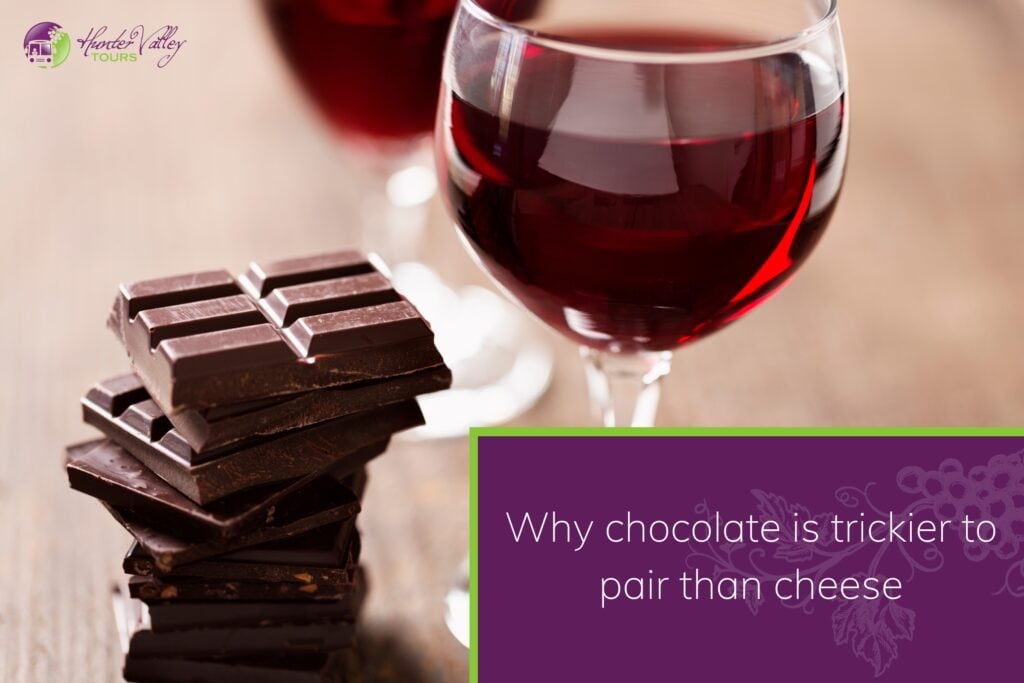
So chocolate isn’t harder to pair because it’s fussy. It’s harder because it changes your palate rather than just sitting next to the wine.
Best chocolate and wine combinations to try
Work up in sweetness and you’ll be fine. Here’s what holds together.
Dark chocolate (70% and above) wants a wine with real body and some sweetness of its own. A fortified red, a tawny, or a rich Shiraz with soft tannins and ripe fruit. Hunter Valley Shiraz helps here because it’s typically medium-bodied with gentler tannins than a Barossa or a Coonawarra Cabernet, so it doesn’t fight the cocoa. Above about 85% cocoa, give up on dry red and go to a muscat or a liqueur style.
Milk chocolate is the easiest of the three and the one most people underestimate. The extra sugar and dairy calm the tannins right down. A tawny is the safe answer, and a botrytis or late-harvest Semillon is the interesting one, since the acid cuts the milk fat while the sweetness keeps pace with the sugar.
White chocolate has no cocoa solids at all, so no tannin, just cocoa butter and sugar. It needs acid and lift rather than weight. Moscato works, sparkling works, and a dessert style with citrus and honey notes works best of all. Don’t put a red anywhere near it.
If a distillery stop is on the itinerary, try dark chocolate with a gin. The botanicals pick up the roasted notes in the cocoa in a way wine can’t.
How the full-day tour structures the tasting order
Order matters more than most people realise, and it’s the main reason a structured wine, cheese and chocolate tour tastes better than doing the same stops yourself in a random sequence.
The day runs dry to sweet and light to heavy. Wine with a cheese board comes first, while your palate is clean and can still read a Semillon properly. Grazing nibbles and further tastings follow, then lunch at a local restaurant or brewhouse, then the chocolate and wine tasting towards the back end of the day. Cellar doors we regularly visit include Binet Wines, Iron Gate Vineyard, Stomp Winery and Hope Estate, with the Hunter Distillery for the gin and vodka tastings, and lunch often at Baume.
Chocolate goes last for a practical reason. Once sugar and cocoa butter are on your palate, everything after tastes flat. Taste chocolate at 10am and you’ve compromised the rest of the day. Taste it after lunch and it’s the finish.
Common pairing mistakes to avoid
- Dry red with sweet chocolate. The single most common error. The sugar makes the wine taste sour and hollow.
- Doubling up on tannin. Very dark chocolate plus a young, firmly tannic red is unpleasant for both.
- Serving chocolate too cold. Straight from the fridge it won’t melt properly, so you lose the aroma the pairing depends on. Let it sit a few minutes.
- Swallowing too fast. Let the chocolate melt, then take the wine while it’s still on your tongue. The pairing happens in that overlap, not one after the other.
For more on the cheese half, our cheese lover’s guide to the Hunter Valley covers the dairies and the standout tastings, and wine pairing experiences in the Hunter Valley looks at what else the region does alongside the glass.
Booking the experience: what’s included on the day
The full-day tour covers wine tasting with a cheese board, a chocolate and wine tasting using small-batch chocolate, further tastings with grazing nibbles, and local gin and vodka tastings depending on which venues are open. A cheese dairy and chocolate factory visit is included where scheduling allows. Transport is air-conditioned with a local guide, and there’s usually some wildlife spotting on the quieter roads between stops.
Lunch is at a local restaurant or brewhouse at your own cost, which keeps the tour price down and lets you order what you feel like.
Pickup is complimentary within 10km of Hunter Valley Gardens, so Pokolbin, Lovedale, Rothbury, Cessnock and Nulkaba are all covered. Newcastle, Maitland and Singleton pickups cost extra, and we can arrange another meeting point if you’re staying elsewhere in the region.
Use code HVT26 when you book. It’s valid through to 31 December 2026.
The Hunter is Australia’s oldest wine region, and Wine Australia has more on what makes its Semillon and Shiraz distinctive if you want the background first. Or just turn up and taste it. That works too.